
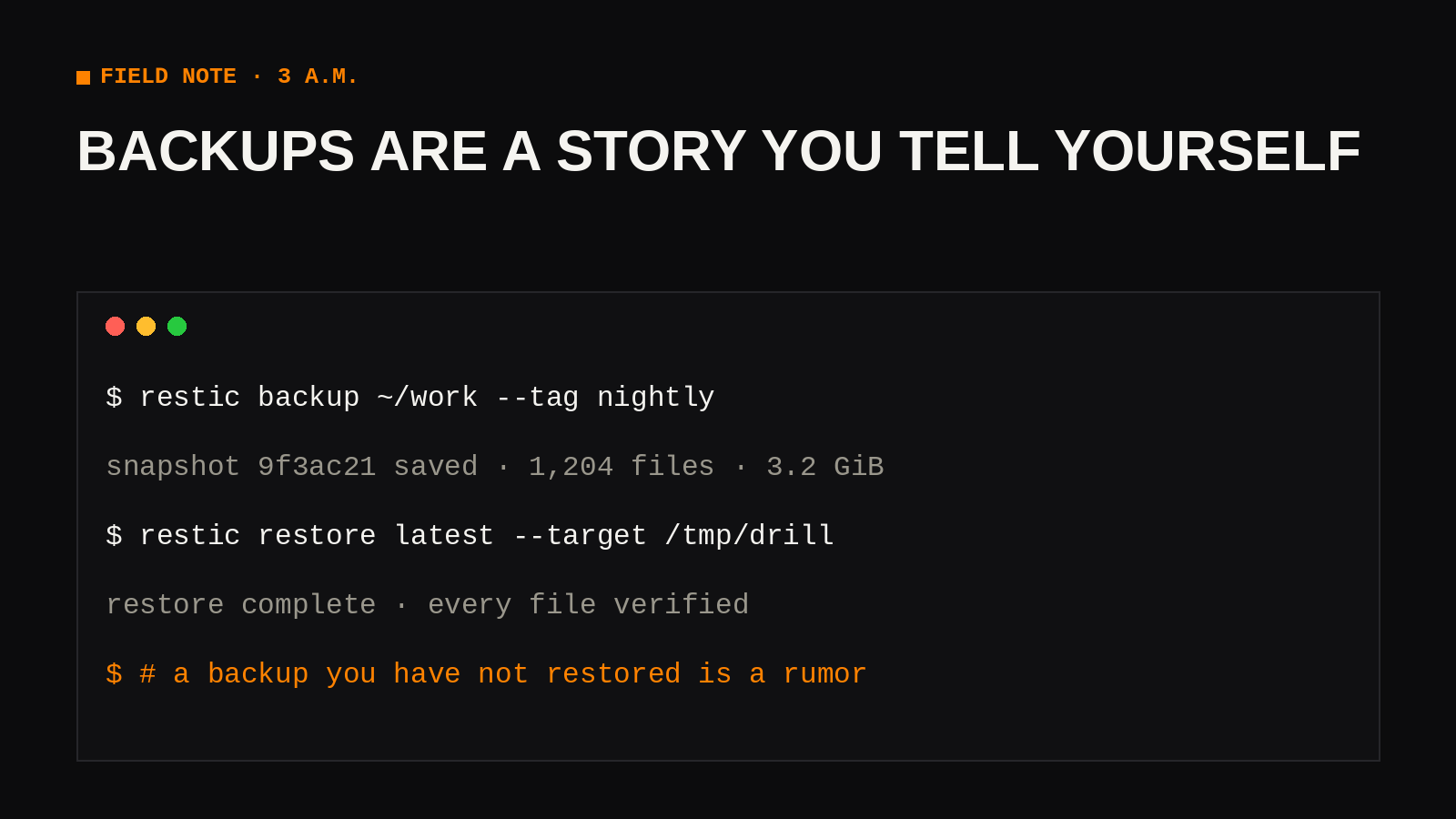
Every backup system reports success right up until the day you need it. The job ran, the log is green, the destination folder grows on schedule. None of that answers the only question that matters, which is whether the files come back. A backup you have never restored is not a backup. It is a rumor with a cron schedule.
01 · THE 3-2-1 SHAPE, IN PLAIN WORDS
The old rule survives because it is simple enough to remember at 3 a.m.: keep three copies of anything that matters, on two different kinds of storage, with one copy somewhere else. Somewhere else means a different building or a different provider, not a different folder. The second kind of storage matters because identical devices share identical failure modes, and a flood, a fire, or a burglar does not care that your copies were logically separate. Three copies sounds like paranoia until the first drive dies on the same week the cloud account gets locked.
02 · SYNC IS NOT BACKUP
Sync tools are wonderful and they are not backups. A sync service propagates changes faithfully and instantly, including the change where you deleted the wrong folder, including the ransomware encryption, including the corrupted save that overwrote the good one. Sync gives you the current state of your files everywhere. Backup gives you yesterday's state, and last month's, when you discover the problem late. Versioned snapshots are the difference between an inconvenience and a loss, and any tool that cannot show you an older version of a file is a convenience, not a safety net. Free tools like restic make proper versioned, encrypted snapshots without drama, and front ends like Backrest put a calm interface on top for people who do not want to live in a terminal.
03 · RESTORE DRILLS ON A SCHEDULE
Restores fail for dull reasons: the password for the encrypted repository lived on the machine that died, the backup quietly excluded the folder that mattered, the external drive was formatted in a filesystem the recovery machine cannot read. A scheduled drill finds these reasons while they are still funny. Once a quarter is enough for most people. Pick a handful of files, including one you deleted on purpose months ago, restore them to a scratch folder, open them, and check they are whole. Write down how long it took. That number is your real recovery time, and it is always longer than the estimate in your head.
04 · LIMITS
Backups do not protect against everything. They will not save a file you never got around to creating, and they will not help if every copy is attached to the same machine during the same lightning strike. A drill takes an hour you will resent spending, four times a year, forever. Storage for real versioning costs money or shelf space, and the off-site copy is always slightly out of date by design. This is the honest price list. It is still cheaper than the alternative, which is explaining to someone which photos are gone.
05 · THE DRILL FOR THIS WEEK
Twenty minutes, no purchases. First, write down the three places your most important folder currently exists, and notice how many of them are real. Second, pick the backup tool you already run and restore one file you deleted last month into a new folder. Third, open it. If any step fails, you have learned the most valuable thing a backup system can teach you, at the cheapest possible price. Fix the step that failed before you touch anything else, because the next failure will not send a calendar invitation.
My oldest backup is a drive in a drawer, and the drill says it still reads, which is the only sentence about it I trust.