
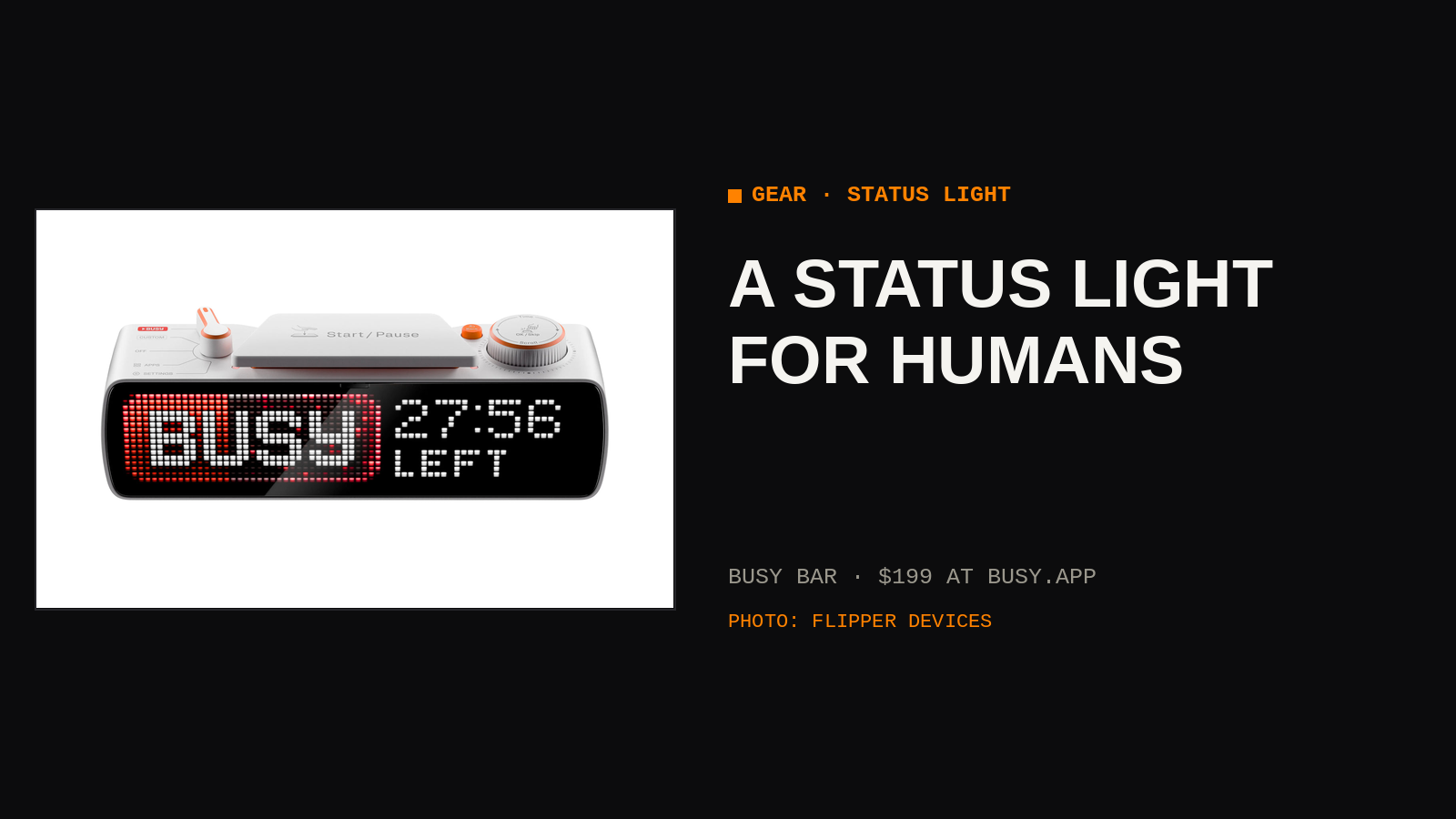
The BUSY Bar is a wide pixel display from Flipper Devices that sits on a desk or hangs by a door and says one word in large lit letters: BUSY, with a countdown under it. That is nearly the whole product, and it raises an obvious question. Why does a sign need a processor, an app, and a timer? The answer is that the sign is not for the person behind it. It is for everyone walking toward them with a question that could have been a message.
01 · WHAT IT IS
| MAKER | Flipper Devices |
| SHOWS | Status text, countdown, clock |
| TIMER | Pomodoro, built in |
| CONTROL | Physical controls, BUSY app, developer API |
| PRICE | $199 at busy.app (checked 2026-11-14) |
Start a focus block and the bar lights up, shows your status, and starts counting down in minutes and seconds. When the counter reaches zero, the sign lets go of you. The hardware is deliberately simple to run: physical controls on the unit for the common moves, so starting a session does not require opening an app and getting distracted by your phone on the way to not being distracted.
02 · THE PROBLEM IS SOCIAL
A knock costs more than the answer to the knock. It costs the thought you were holding when it arrived, and the thread you have to rebuild afterward. Saying "not now" in person spends goodwill every time, because to the person knocking it feels like a judgment about them. A sign spends nothing. It said no before they reached the door, impersonally, the way a red light says no. The countdown does the second half of the job: it answers "how long" without a conversation, which turns "do not disturb" into "back at 2:40", a promise a household or an office can actually plan around. In a shared house, an RV, or a small office with one door worth defending, that difference is the whole product.
03 · TIMER, APP, AND API
The built-in Pomodoro timer runs the classic pattern of focused blocks separated by short breaks, adjustable to taste, and the bar keeps the time where your eyes already are instead of on the phone you are avoiding. The BUSY app handles the rest from a chair: custom messages for the display, schedules, and the settings you change twice a year. For the automation-minded, a developer API lets the sign take orders from software. A calendar event can flip it to BUSY when a call starts. A script can light it while a recording or a build runs. The sign stops being a thing you remember to set and becomes a thing your tools set for you, which is when it starts working every day instead of on motivated days.
04 · THE LIMITS, PLAINLY
It costs $199, which is real money for a sign, and honesty requires saying so before the features. It cannot make anyone respect it. A household that walks through a closed door will walk past a lit sign, because the bar enforces nothing; it communicates, clearly and in advance, which is most of what enforcement was ever made of. The countdown also cuts both ways. It works only if the person behind it keeps the appointment it advertises and actually emerges when the timer ends, every time, until the sign's word is good. Used as a decoration, it decays into an expensive way to say nothing. Used as an agreement, it holds.
Mount it where the knocks happen, agree as a house what the lit letters mean, and come out when the timer ends.
WHERE TO GET ONE
BUSY Bar is sold by Flipper Devices at its own store, $199 (checked 2026-11-14): busy.app