
BASIS
Basis: hands-on, one unit. Claimed free with a Muse subscription, paired to a working home network the day it arrived, used to read a printer across the room, then opened on the bench the same evening. Program terms checked 2026-11-27.
The Muse Home Link is a bridge Meta built so its AI agent can reach the devices on a home network: lights, televisions, printers, anything with a local web interface. It is also a test of a question this site keeps circling, which is what an agent actually needs to be useful inside a house. We claimed one, plugged it in, let it look around our network, and then took it apart to see what it is.
01 · WHAT IT DID ON A REAL NETWORK
Setup is short. The puck plugs into any USB power source, a phone pairs it over Bluetooth, and it joins the Wi-Fi. Ours came up on firmware 1.0.8 and reported its own health back: signal, address, tunnel status. The Bluetooth radio works only during setup and then goes quiet.
The agent gets exactly two tools that belong to the device itself, a health check and a network discovery scan. Everything else is a tunnel: the Link carries web requests from the agent to devices on the local network and carries the answers back. On our network the scan found seven other devices: the router, a Brother printer, an LG television, the PC the Link was plugged into, and three more that could be identified only by their network adapters.
Through the tunnel we opened the printer's status page, which answers without a login. The ink page gave the printer's own estimates, black good for roughly 1,350 pages and the three colors down near 300 each. Small as it sounds, that is the shape of the product's usefulness: the agent can check the printer before a print job instead of reporting a failure after one.
02 · THE HARDWARE, HONESTLY
| CHIP | Espressif ESP32-C5, 32-bit RISC-V at 240 MHz, under a soldered shield can |
| MEMORY | 8 MB PSRAM; 8 MB flash on a separate XMC XM25QH64DHIQ chip beside the can |
| WIRELESS | Dual-band Wi-Fi 6 (2.4 and 5 GHz); Bluetooth LE for setup only |
| POWER | USB-C plug, 5 V at 0.5 A, power only; a USB-C to USB-A adapter is in the box |
| SIZE | 35 x 42 x 10 mm; the board inside is round and a penny wide across |
| PRICE | Not sold. Included with an active Muse subscription in the USA, one per subscriber |
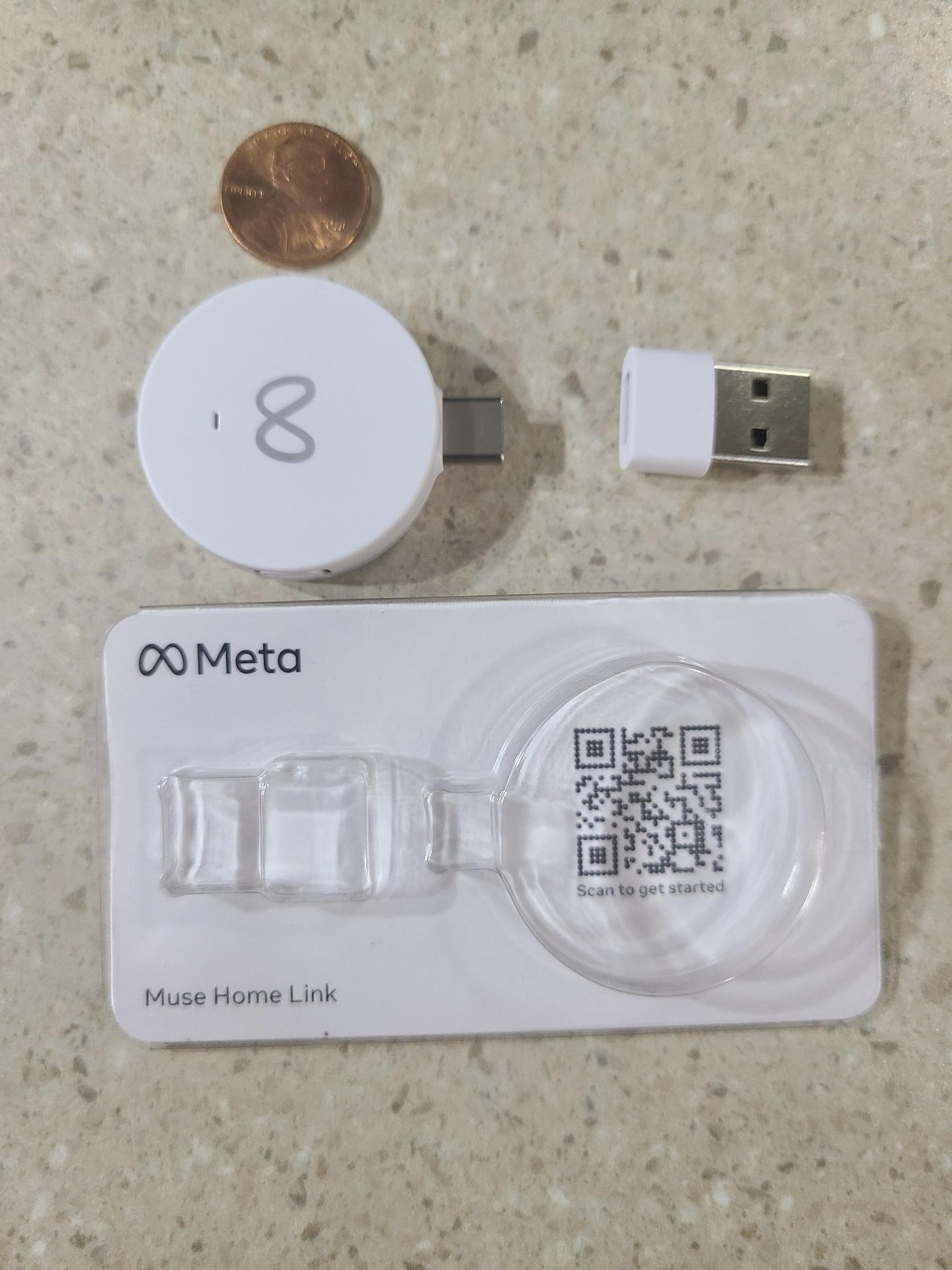
FIG. A · EVERYTHING IN THE BOX. THE ADAPTER MEANS ANY USB PORT IN THE HOUSE CAN HOST IT.
Read the table and the radio is the product. The processor is a microcontroller, the class of chip that runs a washing machine, because the Link never renders or decides anything. The USB plug deserves its sentence: it carries power and nothing else. We plugged the unit into a computer before pairing and watched the bus; nothing enumerated, no device of any kind. Any charger brick can host it, and no host computer can talk to it. The adapter in the box widens that further, to the USB port on a router or the back of a television.
03 · OPENED ON THE BENCH
Meta's user guide says not to open the device, and that there are no user-serviceable parts inside. The second half is accurate. The shell is two snap-fit halves with no screws, and it came apart clean and went back together the same way. The lower half carries a metal plate, part weight, part shielding. The board is a single round PCB, 0.8 mm thick.
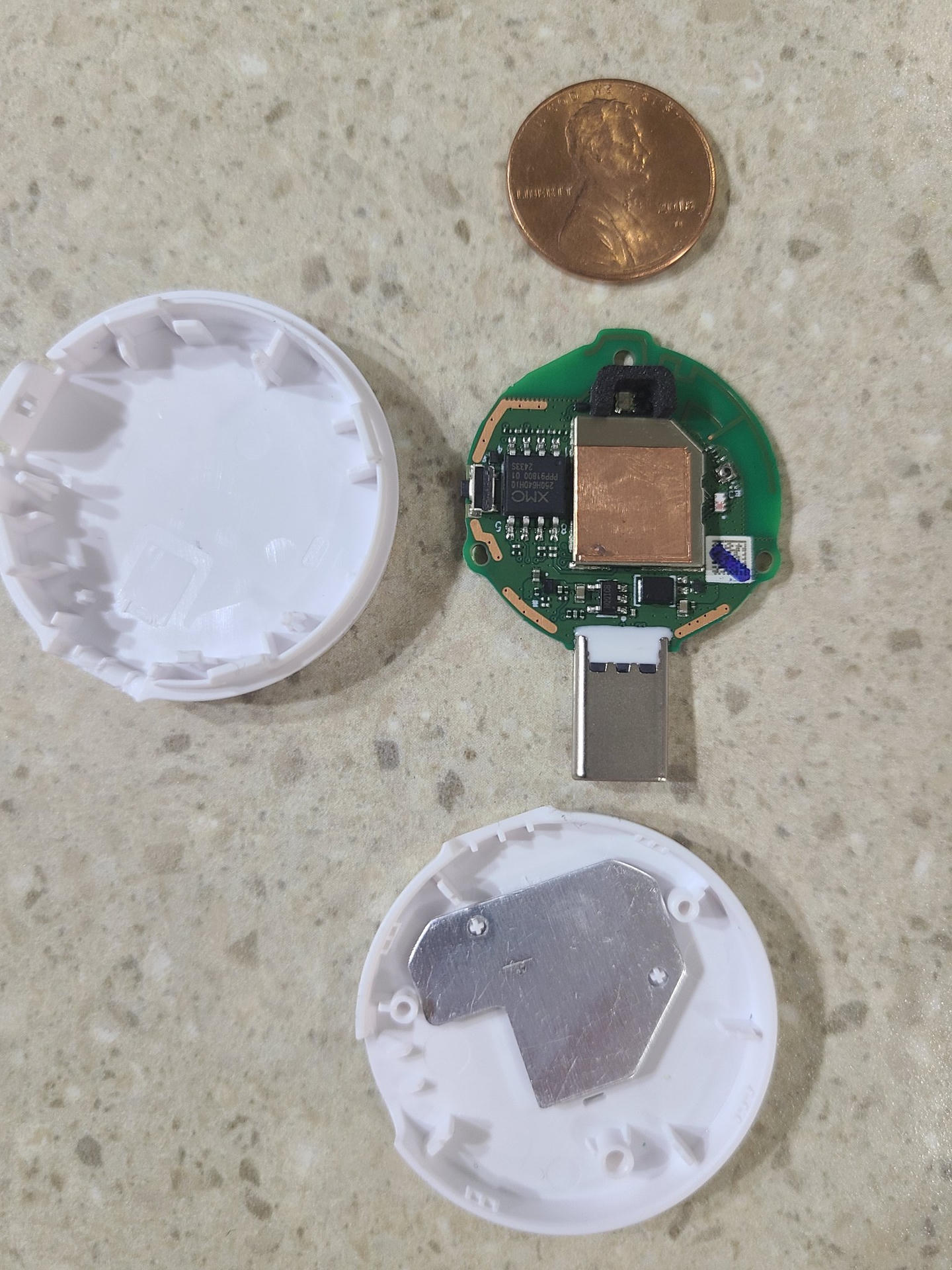
FIG. B · OPENED. THE PROCESSOR LIVES UNDER THE CAN; THE FLASH CHIP SITS BESIDE IT, IN THE OPEN.
The processor hides under a soldered shield can with a copper lid, and we left the can shut. The interesting part sits beside it, in plain sight: the flash memory is a separate chip, an XMC XM25QH64DHIQ, a standard 8 MB SPI part that any hobbyist can order for about a dollar. The antenna is a trace drawn around the rim of the board, and a row of small gold test pads along the back edge is where a factory bench would talk to the unit.
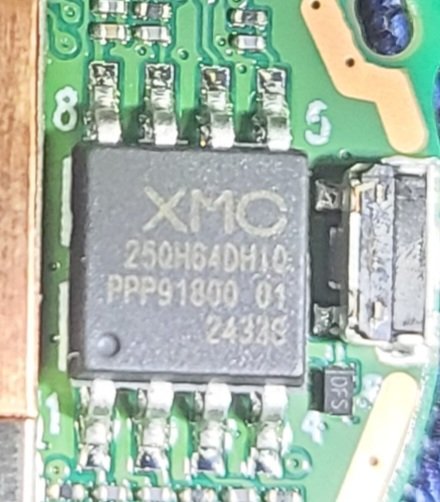
FIG. C · THE FLASH, CLOSE ENOUGH TO READ. A COMMODITY PART, NOT A VAULT.
That one chip reframes the maker's central claim. The Link is documented as running only official firmware, impossible to reflash, and nothing about the hardware makes that true. The parts are commodity parts. The claim rests on the processor's security settings, which is a policy enforced in silicon configuration rather than in exotic components. Whether the policy holds against a test clip and a cheap programmer is a question we have not answered: the clip is a ten-dollar part, it is not in our kit yet, and this review does not grade tests it did not run. If the clip arrives, that experiment becomes part two.
04 · THE LIMITS, PLAINLY
It is a pipe with a periscope. Two commands of its own, and beyond them only the tunnel. The device offers no configuration surface and keeps no log an owner can read when something fails; repair means replacement. When it works, it is invisible. When it stops, it is a puck.
It depends on Meta's cloud and a Meta account at every step. The unit is registered to the subscriber who claimed it, which makes it a poor instrument for mischief and a real dependency for honest use. If the service behind it ever goes away, the hardware becomes a paperweight with a well-drawn antenna.
In this house, it changes nothing. A Tailscale network already reaches every device the scan found, with tooling we own and control. The Link's honest audience is a Muse subscriber with no VPN and no homelab, who would like their agent to be able to check the printer and the television. For that reader it is a tidy piece of work: one plug, one pairing, and nothing new to pay for beyond the subscription already running.
The planted-device scenario writes itself, a puck slipped onto a guest network while an agent looks around, and it mostly defeats itself. The unit answers to a named account, the tunnel passes web requests rather than raw network access, and guest networks usually keep their clients apart from each other. The capability is real. The tradecraft is bad.
As a product, the Home Link is a narrow bridge, honestly built, for people who do not already have one. As an object it is more interesting than that: the first piece of hardware whose whole job is to give an AI agent a presence in a physical place. Ours is clipped back together and back in its box, which is where a specimen belongs, until the clip arrives.
WHERE TO GET ONE
The Home Link is not sold anywhere. Meta includes one with an active Muse subscription in the United States, one per subscriber, from an initial batch of 5,000 units, claimed through the Muse Gadgets page. Terms checked 2026-11-27. This shop does not stock it, and there is nothing to buy here; the link is the whole path.