
BASIS
Basis: Raspberry Pi's published specifications and product documentation. Not stocked here, not bench-tested here. Nothing below is a hands-on claim; the prices named are the maker's list price and the reseller terms on the maker's own page, checked on the date in the buy box.
The Zero 2 W is a full Linux computer on a board the size of a stick of gum: 65 by 30 millimeters, a quad-core 64-bit processor, Wi-Fi and Bluetooth built in, a camera connector, and a 40-pin GPIO footprint. Raspberry Pi sells it for $15. That price has survived since the board launched in October 2021, which makes it the cheapest Pi on sale that runs a modern 64-bit operating system, and the easiest gadget on this site to oversell. The honest version is more interesting than the pitch.
01 · THE HARDWARE, HONESTLY
| CHIP | RP3A0 system-in-package: Broadcom BCM2710A1, quad-core 64-bit Arm Cortex-A53 at 1 GHz, 512 MB LPDDR2 SDRAM in the same package |
| WIRELESS | 2.4 GHz 802.11 b/g/n Wi-Fi, Bluetooth 4.2 and Bluetooth Low Energy, onboard antenna |
| VIDEO | Mini HDMI port; H.264 and MPEG-4 decode at 1080p30, H.264 encode at 1080p30, OpenGL ES 1.1 and 2.0 |
| PORTS | One micro USB 2.0 port with OTG, one micro USB power port, microSD card slot |
| CAMERA | CSI-2 camera connector |
| GPIO | HAT-compatible 40-pin header footprint, unpopulated; composite video and reset pins on solder points |
| SIZE | 65 x 30 mm, same outline as every Pi Zero since 2015 |
| LIFESPAN | In production until at least January 2030, per Raspberry Pi |
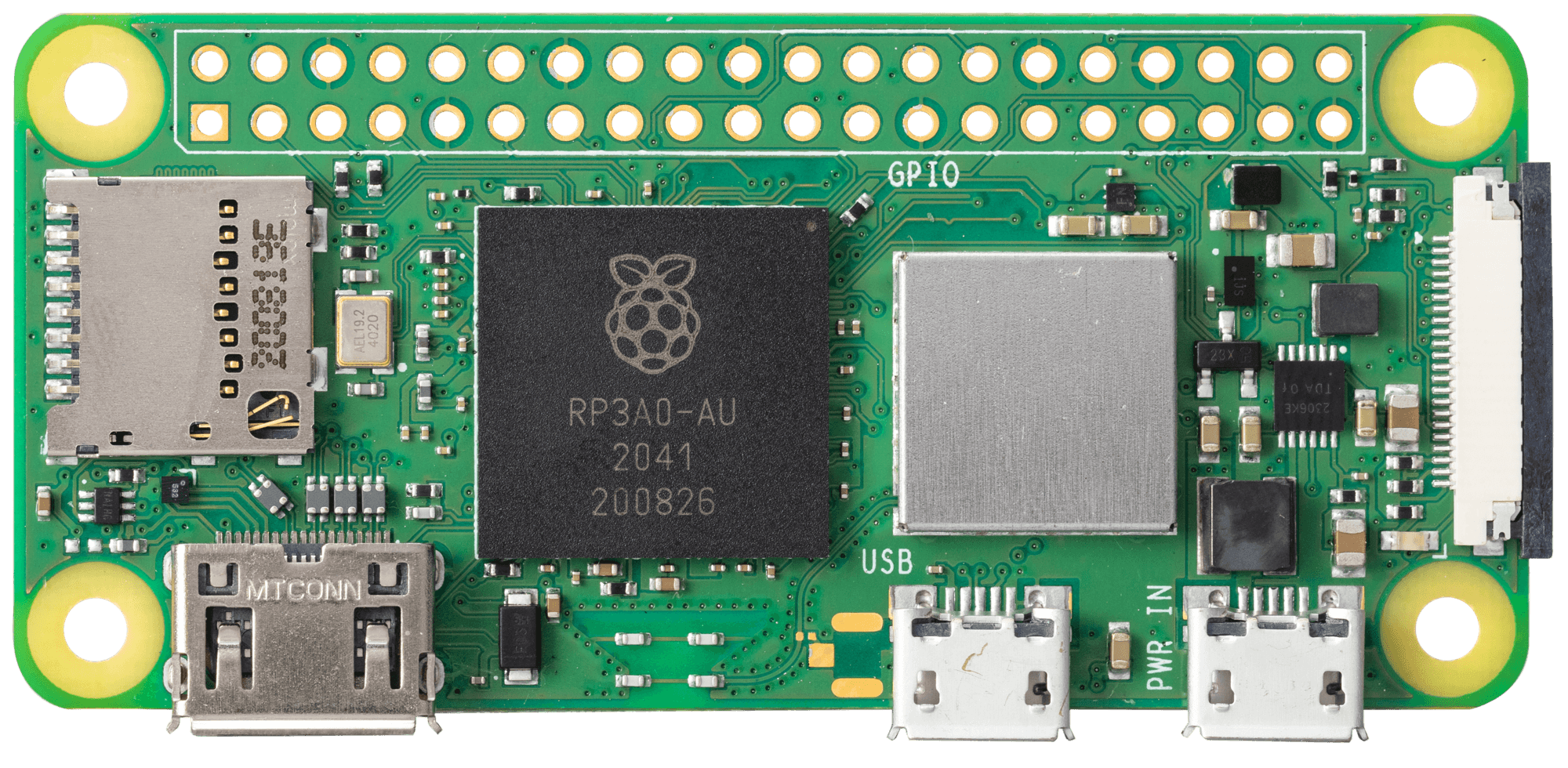
FIG. A · THE BOARD, ALL 65 MM OF IT. PHOTO: RASPBERRY PI.
The chip is the story. The original Pi Zero ran a single-core processor from the first Pi; the Zero 2 W carries the BCM2710A1, the same die as the launch Raspberry Pi 3, with its four Cortex-A53 cores clocked at 1 GHz and the memory stacked into the same package. Raspberry Pi rates it at five times the multi-threaded performance of the original Zero. Cases, cables, and HATs sized for any earlier Zero fit this one, because the board outline never changed.
02 · WHAT FIFTEEN DOLLARS ACTUALLY COVERS
Fifteen dollars buys the board. A working setup needs more, and the extras are where the real price hides. Storage is a microSD card you supply. Power is a 5 V micro USB supply; the official one is $8. A screen means a mini HDMI adapter or cable. A keyboard means a micro USB OTG adapter, because the board's one data port is the small connector. GPIO work starts with a soldering iron, since the header footprint ships unpopulated, or with the Zero 2 WH variant, which carries the header fitted from the factory. Priced honestly, the first working setup lands between $30 and $40. That is still cheap for a computer. It is not fifteen dollars, and listings that pretend otherwise are selling the board as a kit it is not.
03 · THE JOBS IT FITS
The board earns its price in headless jobs: work it does alone, on little power, for months at a stretch. A network service like a Pi-hole ad blocker. A camera node on the CSI-2 connector, watching a printer, a bird feeder, a front door. A sensor logger reading the GPIO pins and filing numbers away. A small print server or status display driver. The 64-bit processor matters in this tier because current operating systems and software packages increasingly assume it; the original Zero's 32-bit chip is the one being left behind. Sized for a pocket and priced for a drawer, it also suits the handheld and embedded builds where a full-size Pi physically does not fit.
04 · THE LIMITS, PLAINLY
512 MB of memory is the ceiling on everything. A desktop runs, and then a browser with a few tabs pushes it into swapping to the microSD card, which is slow storage on its best day. Every job in the section above fits under that ceiling; most jobs people imagine first, a desktop replacement or a compile box, lean on it hard. Wi-Fi stops at 2.4 GHz. The connectors are the miniature versions, so adapters multiply in the drawer. Sustained hard work inside a closed case calls for a heatsink; the board has no fan and no thermal headroom to spare. None of this is hidden in the documentation. It is printed in the spec list, in the same type size as the price.
Buy it for a job you can name in one sentence: block ads for the house, watch the printer, log the greenhouse. If the job needs a comfortable desktop or memory to spare, the honest move is to put the fifteen dollars toward a bigger Pi and skip the disappointment. If the job is small, quiet, and always on, this board at this price has no real rival.
WHERE TO GET ONE
Raspberry Pi sells the Zero 2 W through its Approved Resellers, listed by country on the maker's product page. List price is $15 for the board on its own; checked 2026-11-21, and stock at list price comes and goes, so a reseller asking well over $15 is charging for scarcity, not hardware. The WH variant with the header fitted costs a little more and saves the soldering. This shop does not stock it.