
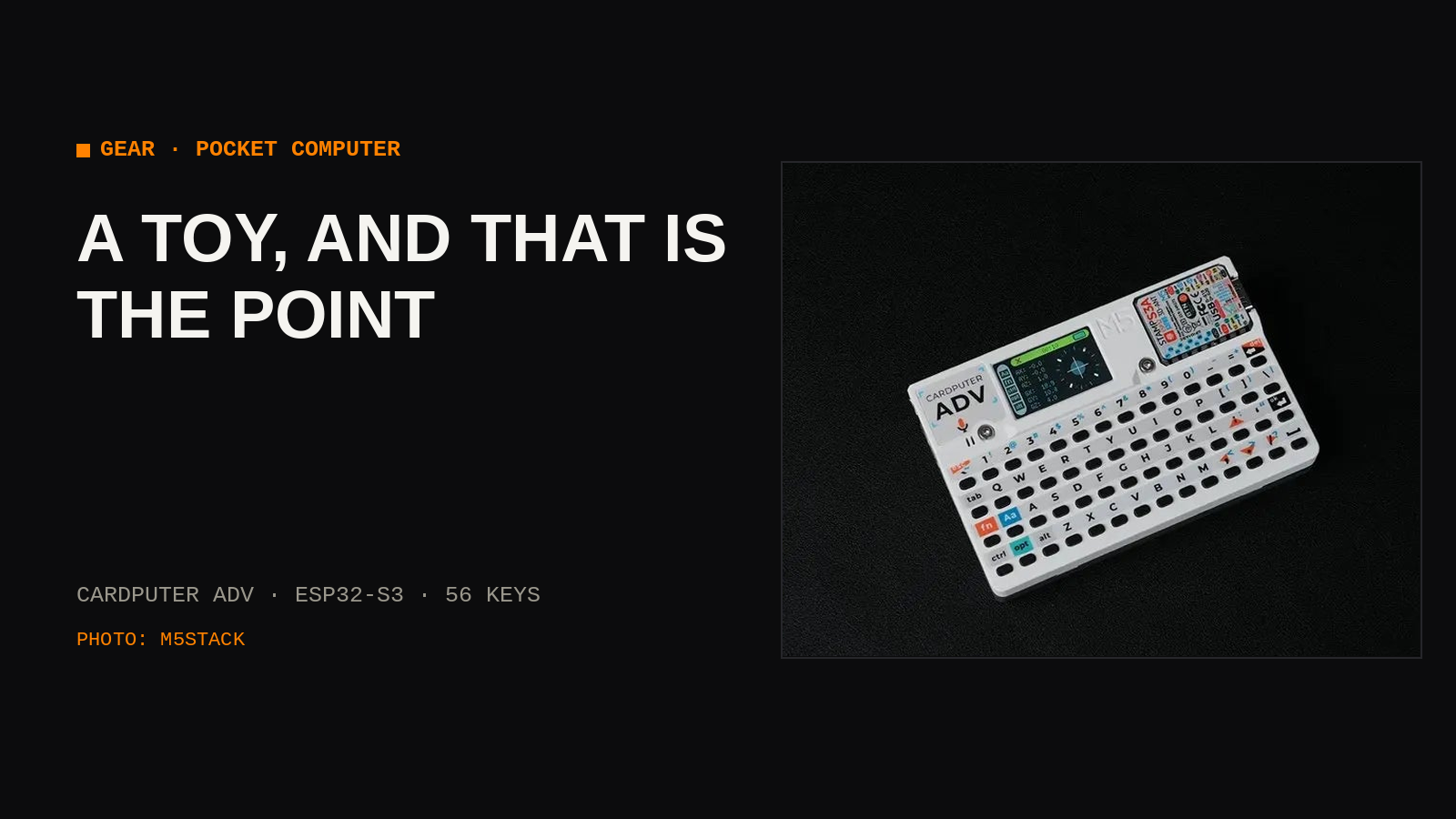
The Cardputer looks like a calculator that lost a bet. It is a pocket computer from M5Stack with a 1.14 inch screen, a keyboard sized for thumbs and optimism, and a speaker with more confidence than range. It is, by any honest measure, a toy. That is not the insult it sounds like. Toys get picked up, carried around, and experimented on without fear, and a computer you are not afraid of is a computer you actually learn from.
01 · THE HARDWARE, HONESTLY
| CHIP | ESP32-S3, Wi-Fi and Bluetooth |
| SCREEN | 1.14 in, 240 x 135 |
| KEYS | 56, thumb sized |
| EXTRAS | microSD, IR transmitter, speaker, microphone, Grove port |
Everything on it is slightly too small, and that turns out to be load-bearing. The screen fits a few lines of text. The keyboard clicks under your thumbs like a BlackBerry remembered by someone who never owned one. Around the edges it is more serious than it looks: an infrared transmitter for talking to TVs and air conditioners, a microphone, a microSD slot for files, and a Grove connector that accepts the whole M5Stack sensor zoo. It is a real ESP32-S3 development platform wearing a toy's body.
02 · WHY A TOY INVITES WORK
Constraint is the invitation. Put MicroPython on a Cardputer and it boots to a prompt in seconds, and the cost of a bad idea is one reset. A laptop invites productivity: updates, tabs, a Slack window judging you. The Cardputer invites a forty line program written standing in the kitchen. Because it lives in a jacket pocket, it is physically present at the moment a small problem appears, and presence is most of tinkering. The physical keyboard matters more than it should. Typing on glass is tolerable; pressing real keys, even tiny ones, makes a timer or a tally counter feel like a tool instead of a web page.
03 · SMALL PROGRAMS THAT FIT
The right size of project for this machine is one evening and one job. A kitchen timer that beeps and flashes until you physically walk over and stop it. A tally counter for laps swum, rows knitted, or boxes packed, with the count saved to the SD card so a dead battery loses nothing. An infrared remote for the workshop television, programmed by pointing the original remote at it and recording what it says. A network scanner that lists nearby access points by signal strength when the Wi-Fi starts acting haunted. A stopwatch. A dice roller that is definitely not rigged. Each of these is a complete, satisfying build, and each one teaches the same loop of input, state, and output that runs every larger machine.
04 · THE LIMITS, PLAINLY
The keyboard is a thumb board. Writing code on it directly is a stunt; you write code on a real computer and load it over, which is fine and also the honest workflow. The battery is small, sized for hours of tinkering rather than days of standby, so it lives near a charger. The screen shows a handful of lines, the speaker is a buzzer with ambitions, and the whole device will not replace a laptop, a phone, or a proper keyboard, and reviewing it as if it should is a category error. Judged as a laptop, it fails. Judged as a toy that teaches, it passes with room to spare.
Put MicroPython on it, write the ugly timer first, and let it ride in a jacket pocket until the next small problem shows up.
WHERE TO GET ONE
The Cardputer is sold by its maker in the official store: M5Stack