
BASIS
Basis: The Pragmatic Programmer, by Andrew Hunt and David Thomas, where the duck first appears in print as a debugging aid; the daily debugging practice of this shop, which runs the method most days; and the free poster linked at the end, which is the method in checklist form. No hardware is reviewed here and nothing in this post is for sale. The duck on this desk cost about two dollars.
The claim survived every silent check I ran on it. The release script for the platform this shop runs on fetches a list of code branches by name and merges them, and my own note at the top of the file said all eighteen branches were ready to fetch. Three of them had never been fetched to that machine at all, so the script would have skipped them without a word. I read the list twice and saw eighteen ready branches both times. The error surfaced when the steps had to be said out loud, in order, to nobody in particular: fetch each branch by name, confirm it exists locally, merge it, run the tests. At the second step the sentence would not finish, because for three branches there was nothing to confirm. That pause, at that step, is the entire product being reviewed here.
01 · WHAT THE DUCK DOES
Reading your own code is a summary act. Your eye crosses a function and your brain reports back the intention: this part loads the file, this part checks the branches, this part works. Explaining is a different act. A listener, even a plastic one, has to be carried through the steps in order, at walking pace, with nothing waved past. The bug almost always lives in a step your summary compresses into "and then it just," and a summary is exactly what an explanation refuses to let you file.
The silence is load-bearing. Explain a bug to a colleague and at minute two they offer a theory, and from then on you are debugging their theory with your afternoon. The duck holds no theories. It does not check its phone, does not remember a similar bug from 2019, and does not need you to be right about anything. It needs you to finish your sentences. Most broken code cannot survive being described accurately, out loud, from the top.
| LISTENER | One duck, silent, unlimited patience, no meetings |
| INPUT | Your explanation, out loud or typed, in execution order, no steps skipped |
| OUTPUT | The sentence you cannot finish. That sentence is the bug's address |
| POWER | None. No battery, no account, no overnight update that changes its personality |
| LATENCY | Instant. It is already on the desk and already listening |
| PRICE | About $2 for a duck. The poster version is free, below |
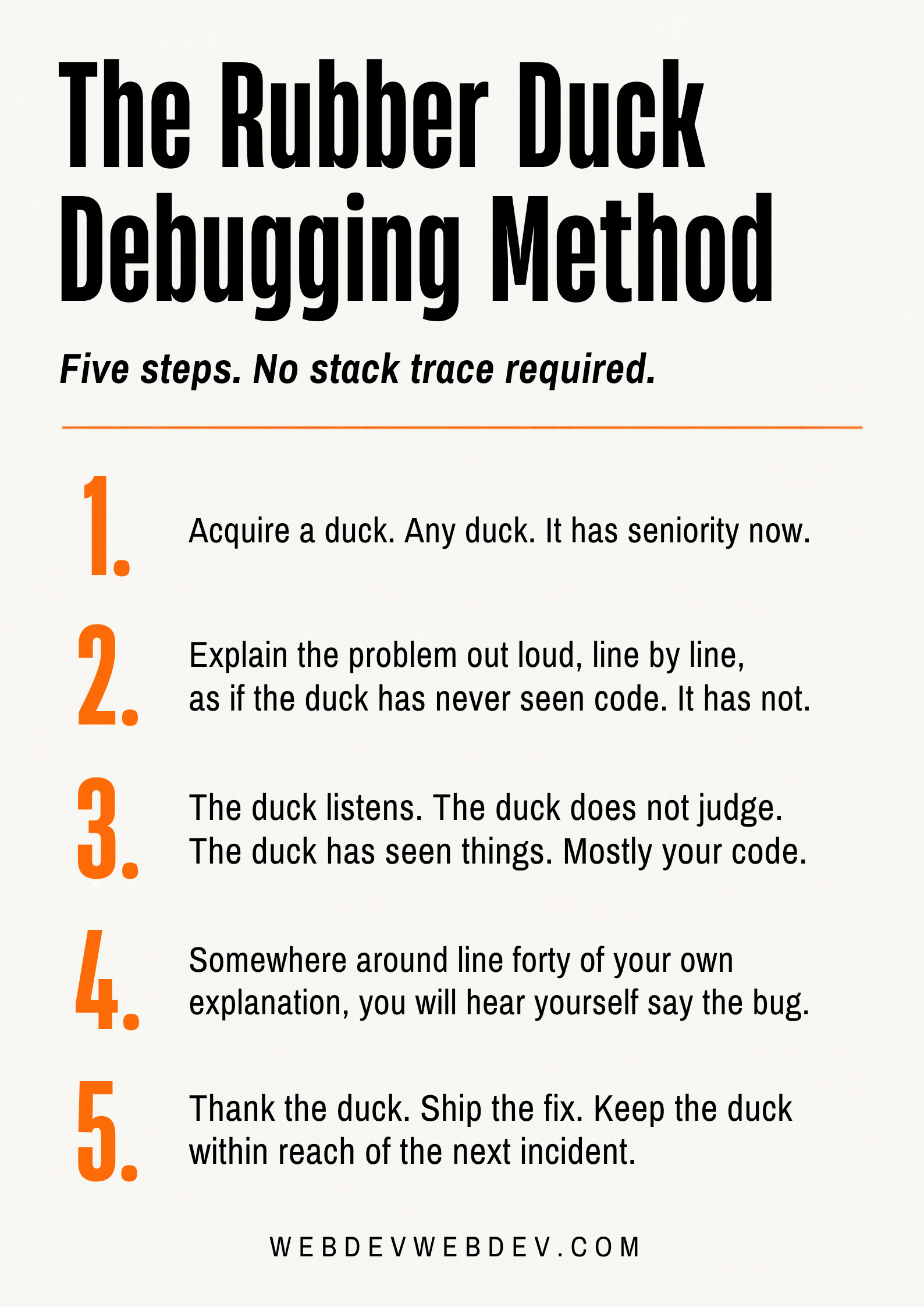
FIG. A · THE RUBBER DUCK DEBUGGING METHOD POSTER. THE METHOD AS A CHECKLIST, FREE FROM THIS SHOP. ART: THIS SHOP.
02 · THE RULES THAT MAKE IT WORK
Start at the beginning, not at the suspicious part. The suspicious part is where your model of the system is most confident and least examined, which is why you find it suspicious in the wrong direction: you keep re-reading the code you already believe. The duck gets the whole story, from the input arriving to the wrong thing leaving, and the setup counts as part of the story. State the environment, the version, the data, out loud. Half of every works on my machine mystery is sitting in the setup paragraph nobody said.
When you hear the word "should," stop. "This list should be complete by then." "That cache should have cleared." Every "should" marks a step you are asserting instead of observing, and bugs breed in the gap between the two. The duck cannot make you go and look. It can make you hear yourself not looking, which turns out to be most of the push a person needs.
Typed counts the same as spoken. A comment written to a future reader, a commit message drafted before the commit, a note to a colleague that never gets sent: if it is in order and it is complete, it is a duck session. The medium is negotiable. The order is not.
03 · WHERE IT FAILS
The duck audits your model of the system. When the model is right and the world is wrong, narration finds nothing, because nothing in your story is broken. A cable that charges a device while refusing to carry its data tells a perfect story and lies about the hardware. A cache serving yesterday's page makes your correct explanation sound insane. A clock set wrong in a log file sends you hunting through code that behaved exactly as written. For that class of bug you need instruments, not narration: a second vantage, a log you trust, a test that touches the real thing. This shop keeps the same rule for backups, where a backup is a story until a restore proves it. An explanation is a story until an instrument checks it. Use the duck first, because it is free and fast. When the story checks out and the bug stays, believe the instruments and go looking at the world instead of the code.
04 · WHY A DUCK
Any patient object works. A plant works. A mug works until you drink from it mid-explanation and lose your place. The duck won the culture for a practical reason: it looks faintly ridiculous, and the ridiculousness is functional. Saying "I do not understand my own code" out loud is the expensive step in most debugging, the one pride keeps postponing. Saying it to a bath toy is cheap. The toy absorbs the embarrassment that would otherwise go toward asking a colleague too early or, worse, toward quietly re-reading the same forty lines for a third hour.
This shop sells nothing in this post, but it does give the method away as a poster, because ducks get borrowed, lost, and sat on, and the method should survive the duck. Print it, pin it where the debugging happens, and the next time a claim survives every silent check you run on it, read the claim to the wall.
THE POSTER
The method as a one-page poster, free from this shop: The Rubber Duck Debugging Method Poster, PNG and print-ready PDF, $0.00, no card and no account. It is the checklist form of everything above, sized for the wall behind the monitor.